


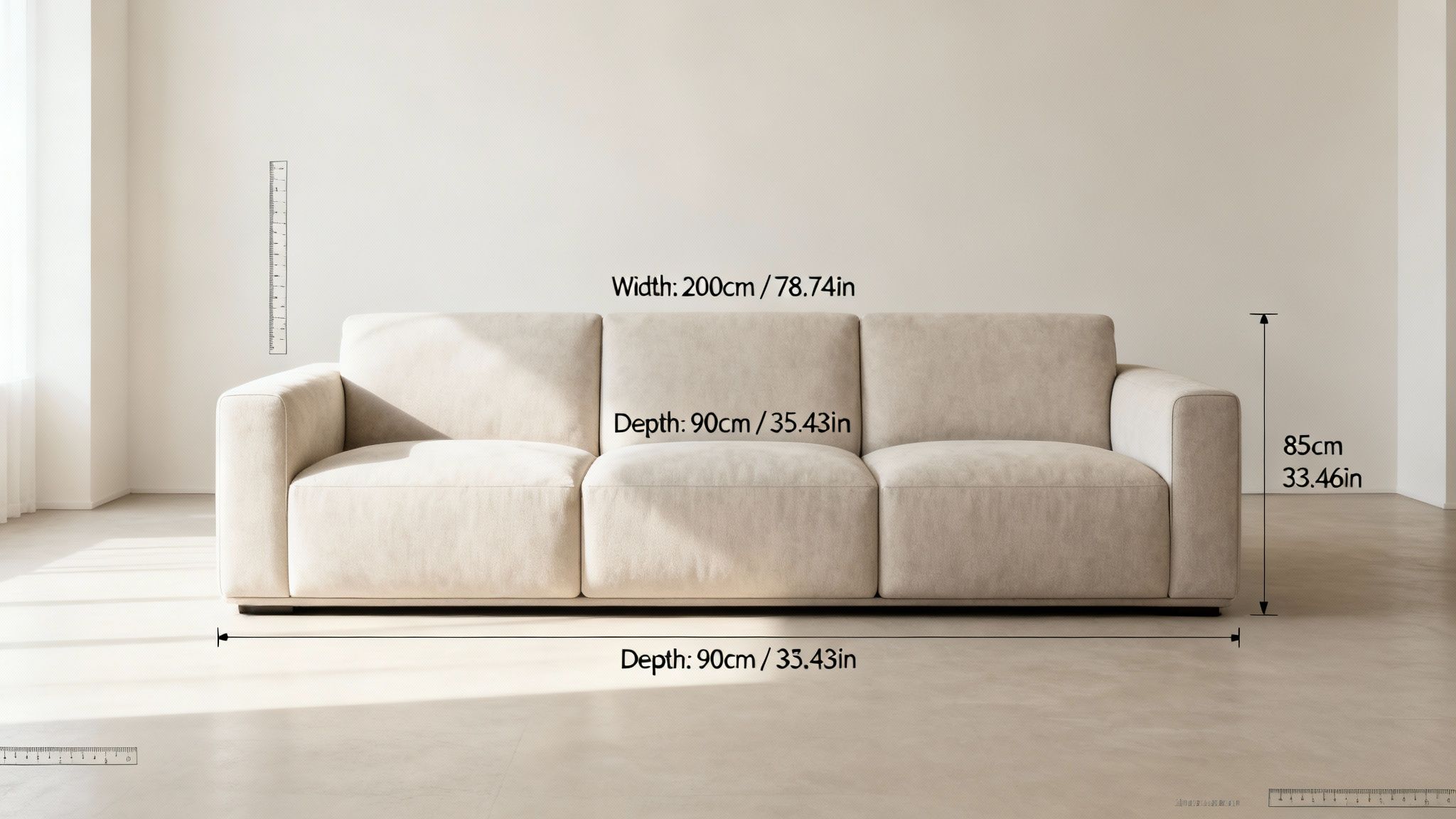
A standard three-seater is usually easier to shop for when you start with numbers, not style names. In most Australian-friendly ranges, you’re looking at roughly 190-240 cm overall width, 75-100 cm overall depth, and 80-95 cm overall height. That gives you the practical baseline for room planning, delivery access, and cover sizing before you get distracted by arm shapes or fabric swatches.
I went back through retailer spec sheets while updating this piece, and the most common mistake I saw was shoppers mixing up overall width with seat width. Those are not the same number. A sofa can look generous for three adults yet lose 20-40 cm of usable sitting space to thick arms and a heavily padded frame.
If you only need the fast answer, use this rule of thumb: a mainstream 3-seater sofa or couch usually lands around 2000-2200 mm wide, with compact designs below that and plush or recliner models above it. A broader global sizing guide from Duroflex puts standard 3-seater width at 183-229 cm, with 213 cm as a common benchmark.
How We Chose These 3 Seat Sofa Dimensions
These ranges are editorial averages drawn from comparing mainstream 3-seater product specs sold through retailer and furniture guide pages, then narrowing them to the dimensions shoppers are most likely to encounter in regular living rooms. I focused on the measurements that matter in real buying decisions: overall width, overall depth, overall height, seat width, seat depth, and seat height.
For this article, a “mainstream 3-seater” means a fixed-frame sofa designed to seat three adults in a standard lounge setting. I excluded oversized modulars, corner sectionals, chaise-ended loungers, and unusually compact apartment loveseats sold under loose naming conventions. Those products can still be marketed as three-seaters, but they distort the range and confuse cover-fit decisions.
I also prioritised dimensions that showed up repeatedly across consumer-facing spec pages rather than one-off designer pieces. In practice, that means the numbers below are intended as a buying reference, not a manufacturing standard. When I compared retailer listings, the overlap was strongest around the middle of the market: sofas around 200-220 cm wide and seat heights in the low-to-mid 40 cm range.
3 Seater Sofa Dimensions in cm and mm at a Glance
For quick planning, here’s the short answer. Most 3-seater sofas and couches fall into these ranges:
-
Overall width/length: 190-240 cm, or 1900-2400 mm
-
Overall depth: 75-100 cm, or 750-1000 mm
-
Overall height: 80-95 cm, or 800-950 mm
-
Seat depth: 55-65 cm, or 550-650 mm
-
Seat height: 41-51 cm, or 410-510 mm
Those seat-height figures align with the ergonomic range cited by Hernest, which notes that most mass-produced sofas sit within 41-51 cm. In plain terms, that’s why many sofas feel familiar even when the silhouettes differ.
If you measure in centimetres, think of a typical three-seater as roughly 2.1 metres wide. If you shop from technical product sheets, the same piece will often be listed as 2100 mm wide. I’ve found this unit mismatch trips people up more often than it should, especially when they’re comparing a cover listing in cm with a furniture page in mm.
The Numbers Behind the Standard
The most useful way to read standard sofa sizing is by separating the dimensions into what they solve.
-
Width/length tells you whether the sofa fits the wall and how many adults can sit comfortably.
-
Depth tells you how far it projects into the room and whether delivery through tight entries is realistic.
-
Height matters for window lines, visual bulk, and some delivery angles.
-
Seat measurements matter for comfort and cover fit.
A practical market range for a standard 3-seater is 190-240 cm wide, 75-100 cm deep, and 80-95 cm high. That sits comfortably alongside the broader international width range of 183-229 cm reported by Duroflex’s sofa sizing guide. For a shopper reading spec sheets, that means a couch listed at 2050 mm x 900 mm x 850 mm is firmly in the mainstream category, not unusually large.
If you’re also thinking ahead to delivery, it helps to treat those dimensions as moving constraints as well as room constraints. A sofa that fits the wall can still fail at the doorway. For a practical primer on lifting and manoeuvring bulky furniture, Get n Go Removals Melbourne's page is a useful reference.
The three figures I tell shoppers to prioritise first are overall width, overall depth, and seat width. Width tells you whether it fits the room, depth tells you whether it overwhelms the room, and seat width tells you whether it actually feels like a comfortable three-seater.
Typical 3-Seat Sofa Dimension Ranges in Australia
This reference table shows the same dimensions in cm, mm, and inches so you can compare retailer product pages, room plans, and cover listings without converting each number manually.
| Measurement | Typical Range (cm) | Typical Range (mm) | Typical Range (inches) |
|---|---|---|---|
| Total width / length | 190-240 cm | 1900-2400 mm | 75-94 in |
| Seat width | 150-190 cm | 1500-1900 mm | 59-75 in |
| Total depth | 75-100 cm | 750-1000 mm | 30-39 in |
| Seat depth | 55-65 cm | 550-650 mm | 22-26 in |
| Total height | 80-95 cm | 800-950 mm | 31-37 in |
| Seat height | 41-51 cm | 410-510 mm | 16-20 in |
These numbers do different jobs. Total width is the key number for wall fit and room layout. Total depth is the one that causes problems in narrow rooms and tight entries. Seat depth affects whether the sofa feels upright or loungy. Seat width matters when two broad arms eat into the usable sitting area. For sofa covers, I’ve noticed shoppers often buy from overall width alone, then wonder why the seat and arm proportions feel off; if you can get only two numbers, prioritise overall width and overall depth, then compare the product photos to your arm style.
| Dimension | Typical Range (cm) | Typical Range (inches) |
|---|---|---|
| Width | 190 cm – 260 cm | 75" – 102" |
| Depth | 75 cm – 90 cm | 30" – 35" |
| Height | 80 cm – 95 cm | 31" – 37" |
| Seat Depth | 55 cm – 65 cm | 22" – 26" |
| Seat Height | 40 cm – 50 cm | 16" – 20" |
Why This Size is So Common
This sizing range dominates because it balances seating capacity with normal living-room proportions. A reference guide from Cousins Furniture notes that 200-220 cm is the most common retail width band, which lines up closely with what appears across mainstream product listings.
That makes practical sense. At around 2.1 metres wide, a sofa can seat three adults without becoming so long that it overwhelms an average wall or complicates transport. In my review of specs, models much under 180 cm tended to feel like generous two-seaters marketed upward, while models beyond 240 cm were usually moving into oversized, modular, or recliner-heavy territory.
How Sofa Style Changes Its Footprint
“3-seater” describes capacity, not shape. A 3-seater couch with slim track arms can be compact enough for a smaller room, while a deep, cushioned sofa with broad rolled arms may take up dramatically more floor space without adding any extra seats.
In sizing terms, sofa and couch are usually interchangeable. Some retailers use couch a bit more casually for softer, deeper silhouettes, while sofa is more common in formal product descriptions, but the measurement logic is the same: compare the overall width, depth, and height, then check how much of that width is usable seating.
The design details that change a sofa’s footprint most are arm width, back thickness, and seat depth. A pair of chunky arms can add 10-15 cm per side and cut into usable seat space. A pillow-back design can add depth without changing the seat count. A recliner mechanism can add both depth and the need for rear clearance. I’ve found arm width is the easiest detail for buyers to underestimate because it looks decorative on a product photo but materially changes the total span.
3-Seater Sofa and Couch Size by Style
| Style | Typical length (cm) | Typical length (mm) | Typical depth (cm) | Typical depth (mm) | Typical height (cm) | Typical height (mm) |
|---|---|---|---|---|---|---|
| Compact / track-arm | 190-210 cm | 1900-2100 mm | 75-88 cm | 750-880 mm | 80-90 cm | 800-900 mm |
| Standard rolled-arm | 210-230 cm | 2100-2300 mm | 85-95 cm | 850-950 mm | 82-95 cm | 820-950 mm |
| Deep-seat / plush | 220-240 cm | 2200-2400 mm | 95-105 cm | 950-1050 mm | 85-95 cm | 850-950 mm |
| Recliner 3-seater | 205-235 cm | 2050-2350 mm | 90-105 cm | 900-1050 mm | 95-105 cm | 950-1050 mm |
A compact track-arm piece usually gives you the best ratio of total width to usable seat width. A standard rolled-arm sofa sacrifices some of that efficiency for softer arm support. Deep-seat styles push further into the room and suit loungers better than upright sitters. Recliner couches often look similar in width to standard models on paper, but the extra mechanism and operating clearance make them behave like larger furniture.
Where Style Changes the Real Fit
A slim-arm sofa that measures 200 cm wide may offer a seat width close to 170-180 cm. A plush rolled-arm version at the same seating comfort can easily stretch to 220 cm overall because the arms consume more of the frame. That difference matters when you’re trying to place the sofa on a wall that is only 240-250 cm long.
Back style matters too. Tight-back and low-back models are usually friendlier in smaller rooms because they stay visually lighter and often shave off a little depth. Pillow-back and scatter-back designs are softer to lounge on, but they can make a room feel tighter because the sofa projects further and reads bulkier from the side.
Measuring Your Space for the Perfect Sofa
It’s easy to fall in love with a sofa’s style, but the key test is whether it will fit in your home. A stunning three-seater is no good to anyone if it can’t make it through the front door. Measure your space properly, looking beyond just the final spot and mapping out the sofa’s entire journey into your living room.
Think of your new sofa as a VIP guest arriving at your home. It needs a clear, unobstructed path from the delivery truck all the way to its destination. This means you need to measure not just the wall where it will sit, but every single doorway, hallway, stairwell, and tight corner along the way. Getting this right from the start saves you from the massive headache of a delivery-day disaster.
To be sure your 3-seat sofa will fit perfectly, it's worth knowing how to measure furniture accurately. Mastering this skill gives you the confidence that your chosen piece will settle into its new home without any drama.
Mapping the Sofa's Journey
Your first job is to become a route planner for your new furniture. Grab a tape measure and a notepad, then walk the exact path the delivery team will take, meticulously measuring the width and height of every entry point.
- Doorways and Entry Points: Measure the width of your doorframe from the inside edge, then measure the height. Don't forget to account for the door itself and any protruding handles that might eat into your clearance space.
- Hallways and Corridors: Check the width of your narrowest hallways. Remember to factor in any permanent obstacles like radiators, console tables, or light fixtures that stick out from the wall.
- Stairwells and Corners: Stairs are often the trickiest part. Measure the width of the staircase and the ceiling height at its lowest point. For corners, you have to think in three dimensions—it’s often the diagonal measurement of the sofa that matters most for pivoting.
Pro Tip: Always measure twice. A simple mistake of a few centimetres can be the difference between a smooth delivery and a returned sofa. It’s a small effort that saves a huge amount of potential frustration.
Standard Measurements Turned Into Room Rules
Here’s the practical version of the standard ranges. A sofa around 190 cm wide usually sits comfortably on a wall of at least 220-250 cm, depending on whether you want breathing room for side tables or just enough clearance to avoid a squeezed-in look. A sofa around 240 cm wide is more comfortable on a wall of at least 270-300 cm.
As a general rule, leave 15-30 cm of clearance at each side if the sofa is wall-bound. Less than that can look cramped and makes cleaning, blinds, and side-table placement harder. In narrow rooms, depth becomes the bigger issue: once your sofa gets beyond about 95 cm deep, it can pinch circulation paths quickly, especially if the room also needs a coffee table and a main walkway.
I’d also encourage buyers to test room depth, not just wall width. On paper, a deeper couch may fit; in practice, it can force the coffee table too close, choke the walkway, and make the room feel front-heavy.
Visualising the Footprint in Your Room
Once you’ve confirmed the sofa can get into the room, it’s time to see how it will live in the room. The absolute best way to do this is to create a physical template right on your floor. You don’t need any fancy tools for this—just some painter's tape.
Using the sofa's official width and depth dimensions, mark out its exact footprint on the floor where you plan to place it. This simple trick takes the sofa from an abstract idea to a tangible presence, letting you see exactly how much space it will really take up. It’s far more effective than just guessing.
This visualisation helps you answer critical layout questions. Will you have enough room to walk around it comfortably? Will it block a doorway, a window, or access to a bookshelf? Does it leave enough space for a coffee table? Seeing the taped outline makes the impact on your room's flow immediately obvious.
For a deeper dive into finding the perfect size cover for your sofa's unique dimensions, our size guide provides detailed instructions to ensure a flawless fit.
This infographic shows how different arm styles, from sleek to standard to plush, can alter the overall footprint of a sofa.
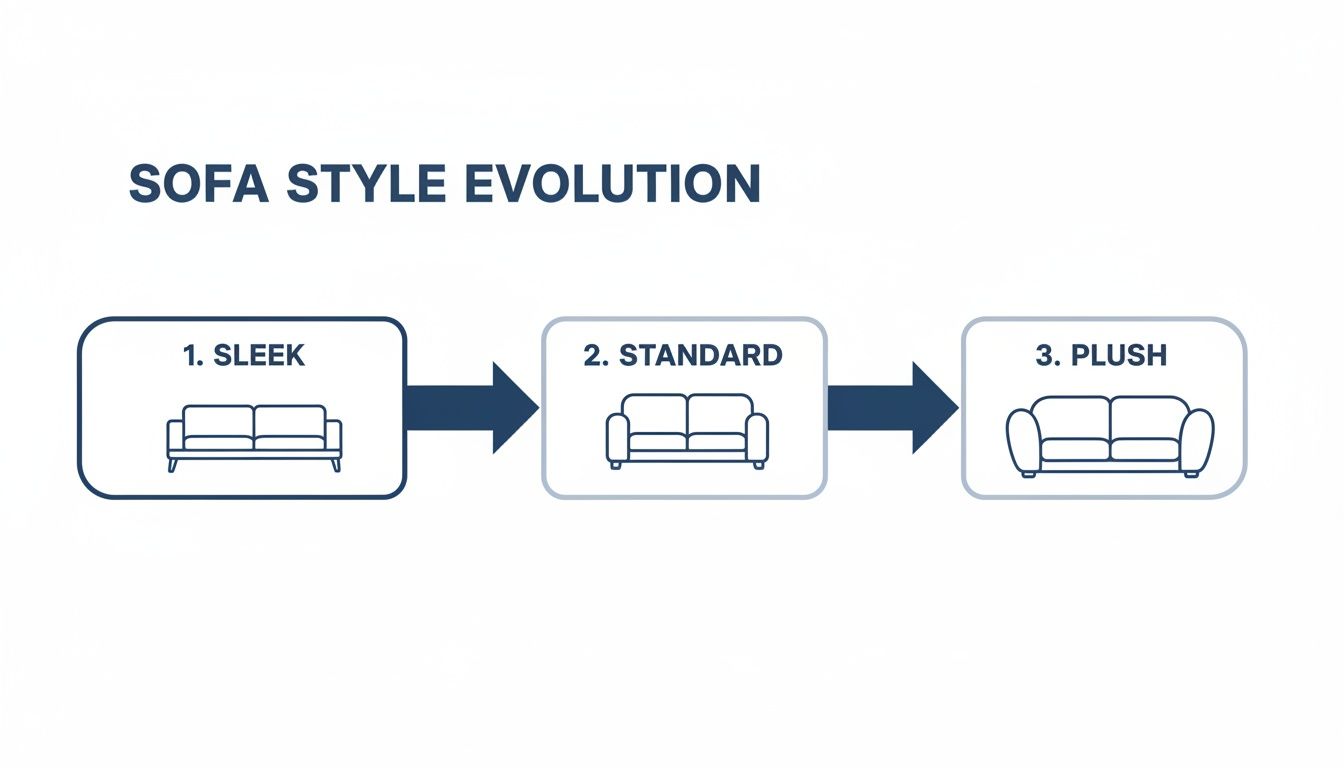
As the illustration highlights, a sofa's design directly impacts its physical size, even if the seating capacity remains the same.
Delivery and Access Checklist
Before you buy, check these three pinch points:
- Doorway height vs sofa depth: if the sofa must be tilted on its side, the depth often becomes the critical number.
- Stair turns and landings: measure both width and turning space, not just the straight stair run.
- Clearance behind recliners: many recliners need extra room behind the back and in front of the footrest to operate properly.
Accounting for the Little Details
Finally, a successful measurement means looking beyond the empty space and noticing the small but important details that can interfere with a perfect fit. These are the elements that are easy to overlook but can cause major issues on the day.
Make sure to account for:
- Skirting Boards: These can push your sofa a few centimetres away from the wall.
- Power Points and Switches: Ensure your sofa won't block access to essential outlets or light switches.
- Radiators and Vents: Placing a sofa directly in front of a heat source can be a fire hazard and will stop heat from circulating properly.
- Window Sills: If you're placing a sofa under a window, check that the height of the sofa's back is lower than the sill to avoid an awkward overlap.
When you’re buying a cover rather than a new sofa, the priority shifts slightly. If the product page gives only overall width and overall depth, start there, then compare the arm shape and cushion layout to your sofa. In my experience, cover fit issues are caused less by a few centimetres of width and more by buyers overlooking arm bulk, back cushion shape, and seat depth.
By following these practical steps, you can move from hoping a sofa will fit to knowing it will. This careful planning turns furniture shopping from a gamble into a confident design decision, guaranteeing your new three-seater becomes a welcome addition, not a logistical nightmare.
Arranging Your Room Around Your New Sofa
Bringing a new three-seater sofa home is always exciting. But once the delivery team leaves, you're faced with the next challenge: making it work in your room. The right layout can take a living space from feeling awkward and cramped to open and inviting. It's all about getting the relationships between your furniture just right.
Think of your new sofa as the sun in your living room's solar system. Every other piece—from the coffee table to the armchairs and side tables—should orbit around it in a way that feels balanced and functional. This isn't just about looks; it's about creating a room that’s easy and comfortable to live in.
Creating Pathways for Comfortable Flow
The first rule of any good room layout is making sure people can move around freely. You need to create clear, unobstructed pathways, often called "traffic lanes," through your living room. A blocked path can make even a big room feel claustrophobic.
Aussie interior designers have a great rule of thumb for this. They suggest leaving at least 75-90 cm of space for any major walkway, like the path from a doorway into the room or the main route to an adjoining area. That’s enough space for two people to pass by each other comfortably without doing that awkward side-shuffle.
A well-planned room is all about flow. Before placing any other furniture, walk the main paths from every entrance to every exit. If you find yourself having to sidestep or squeeze past imaginary objects, your layout needs a rethink.
This is particularly important when you're working with the generous 3 seat sofa dimensions. A deeper sofa might force you to rethink the entire room's flow just to keep those essential pathways clear.
The Sofa and Coffee Table Relationship
One of the most common layout mistakes I see is placing the coffee table miles away from the sofa. It forces people to do an awkward lunge forward just to set down a drink or grab a book, which pretty much defeats its purpose. The sweet spot is closer than you might think.
Aim for 40-45 cm between the edge of your sofa and your coffee table. This is close enough for easy reach but gives you just enough legroom to sit and stand up without any trouble. This simple tweak instantly makes the whole seating area feel more connected and usable.
For size, your coffee table should be about two-thirds the length of your sofa. For a standard 210 cm three-seater, you'd be looking for a coffee table around 140 cm long. This keeps everything looking visually proportionate.
Give Your Sofa Some Breathing Room
It seems logical to shove your sofa right up against the wall to save floor space, right? But this can often have the opposite effect, making the room feel smaller. Pulling your sofa even just a few centimetres away from the wall creates a sense of airiness that can make the entire room feel larger.
This tiny gap creates what designers call a "shadow line," adding depth and dimension to the space. For a standard 2,100 mm sofa, Australian datasheets often suggest allowing 150–300 mm of clearance at each end if it's placed along a wall. This means the ideal wall length should be between 2,400–2,700 mm to stop it from looking cramped.
This little bit of extra space also opens up some great styling opportunities. It’s the perfect spot for a slim console table, a sleek floor lamp, or a few tall plants to add some layers to your decor. If you're hunting for more ways to dress up your sofa's new spot, check out our guide on 11 creative ways to style your sofa with covers.
Finding the Right Sofa Cover Fit
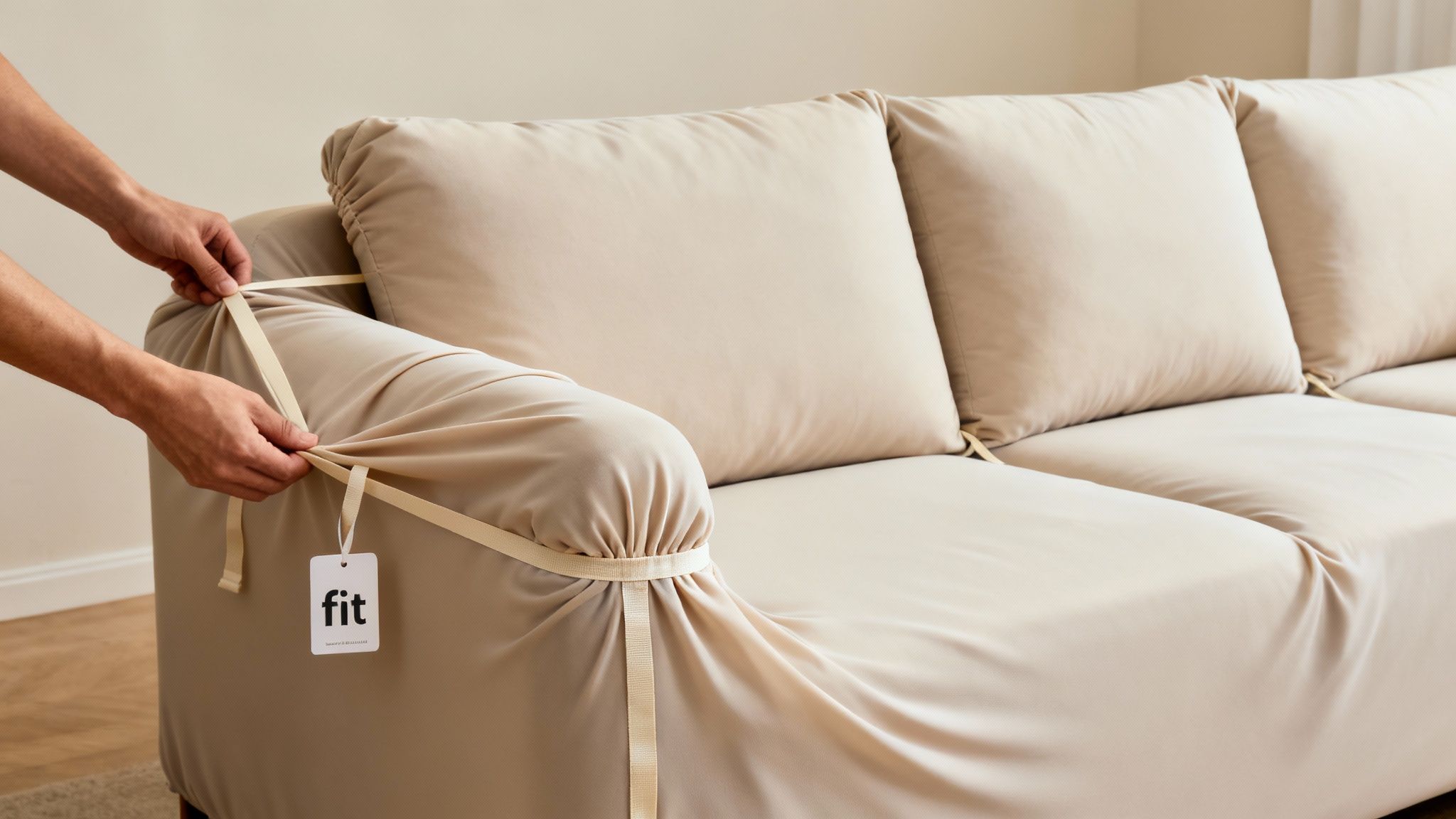
Alright, you’ve carefully measured your sofa. The next step is turning those numbers into a slipcover that looks like it was made just for your couch. Clever design and modern fabrics come together, giving you that polished, custom-upholstered look without the hefty price tag. The secret is a combination of super-stretchy materials and smart little features that hold everything in place.
Think of a great sofa cover like a well-made jumper. It needs enough give to fit different shapes—broad shoulders or a narrow waist—without looking baggy or overstretched. A quality slipcover does the same thing, using its elasticity to hug every curve of your sofa, from uniquely shaped arms to plump back cushions.
It’s this adaptability that makes a single cover work across a whole range of 3 seat sofa dimensions. The trick is finding one that’s engineered to stretch and conform, so it looks intentional, not like a temporary, ill-fitting sheet.
The Magic of High-Stretch Fabric
What makes any great-fitting slipcover work is the fabric itself. We're talking about high-quality spandex blends, materials chosen specifically for their incredible stretch and memory. They can expand to fit over your sofa, then snap back to create a snug, smooth finish.
This built-in stretch is what solves so many common fit problems, effortlessly dealing with the subtle differences between sofa styles.
- Accommodates Arm Shapes: Whether you have sleek track arms, classic rolled arms, or something more sculptural, the fabric stretches to conform without any awkward pulling or creasing.
- Adapts to Cushion Plumpness: Overstuffed, pillowy cushions are no problem. The material expands to cover them fully and then settles snugly into all the crevices.
- Forgives Minor Measurement Errors: That inherent flexibility gives you a small margin of error, so being a centimetre or two off in your measurements won't ruin the final look.
A well-designed stretch cover is the ultimate problem-solver. It bridges the gap between the standardised dimensions of your cover and the unique, specific measurements of your individual sofa, creating a seamless and tailored appearance.
When you're choosing a cover, the fabric composition is everything. A higher percentage of spandex usually means better stretch and recovery, so the cover will hold its shape better over time, even after a few trips through the wash. For anyone thinking of making their own cover, it's vital to use materials designed for this kind of tension, including specialised supplies like quality upholstery thread that can handle the constant pulling.
Achieving a Secure and Smooth Finish
While stretchy fabric does most of the heavy lifting, a great fit is all in the details. Without the right fastening and tucking system, even the best material can end up looking messy. These features are designed to fight the slipping and bunching that plague poor-quality covers.
Think of it as the final step in "dressing" your sofa. These elements are what tuck, tighten, and secure the fabric for that crisp, upholstery-like finish. At The Sofa Cover Crafter, we've focused on a few key components to make sure you get a flawless result.
- Under-Sofa Straps: These are essential for keeping the cover anchored. Strong elastic straps run underneath the sofa, pulling the fabric taut from all sides and stopping the hem from riding up when you sit down.
- Foam Tuck-Ins: These simple foam cylinders are absolute game-changers. You push them deep into the gaps between the cushions and the sofa frame, locking the excess fabric in place and creating clean, defined lines.
- Elasticised Hem: A continuous elastic band sewn into the bottom edge helps the cover grip the base of the sofa, a bit like a fitted sheet on a mattress.
These features all work together to ensure your cover not only protects your sofa but also makes it look fantastic by conforming perfectly to its shape. For more inspiration on transforming your furniture, you can explore our detailed guide to fitted slipcovers for sofas. By combining precise measurements with these smart design features, you can achieve a fresh, updated look that is both stylish and practical.
Got Questions About Sofa Sizing? We’ve Got Answers.
How many centimetres is a 3 seater couch?
Most 3-seater sofas and couches are about 190-240 cm wide, with the most common mainstream range sitting closer to 200-220 cm. Compact models can be shorter, while plush and recliner styles often run longer.
What is the average depth of a 3 seater sofa?
The average overall depth is usually 75-100 cm, or 750-1000 mm. If you want the sitting area only, seat depth is more often 55-65 cm. Upright sofas sit near the lower end; loungier couches sit near the upper end.
What’s the real difference between a 3 seater and a 2.5 seater?
A 2.5 seater usually falls around 175-210 cm wide and is meant to give two adults more space without taking the full footprint of a standard three-seater. In practical terms, it’s the in-between option for rooms where a full 3 seater feels too dominant.
How do I know if the sofa will actually fit through my doorway?
Compare your doorway height and width with the sofa’s depth, height, and diagonal measurements. In many deliveries, the sofa is tipped on its side, so the depth can matter more than the width. Also measure hall turns, stair landings, and anything that narrows the path.
Do recliner mechanisms change the standard dimensions?
Yes. Recliner sofas are typically deeper than fixed sofas and need extra space to operate. Check both the closed depth and the fully reclined depth, plus the rear wall clearance listed by the retailer.
What’s the 2/3 sofa rule?
It’s a layout rule that says a coffee table should be about two-thirds the length of your sofa. So if your sofa is 210 cm long, a coffee table around 140 cm usually looks balanced and stays easy to use.
What’s the difference between a ‘sofa’ and a ‘couch’?
For sizing, usually none. In modern Australian English, the two words are mostly interchangeable. Some retailers use couch for softer, more casual silhouettes, but you should still judge the piece by the same measurements: width, depth, height, and seat size.
With the right measurements and a clear understanding of your space, you can transform your living room with confidence. At The Sofa Cover Crafter, we make it easy to protect your new investment or give an old favourite a fresh new look.
Explore our collection of stylish, stretch-fit sofa covers designed for Australian homes.